
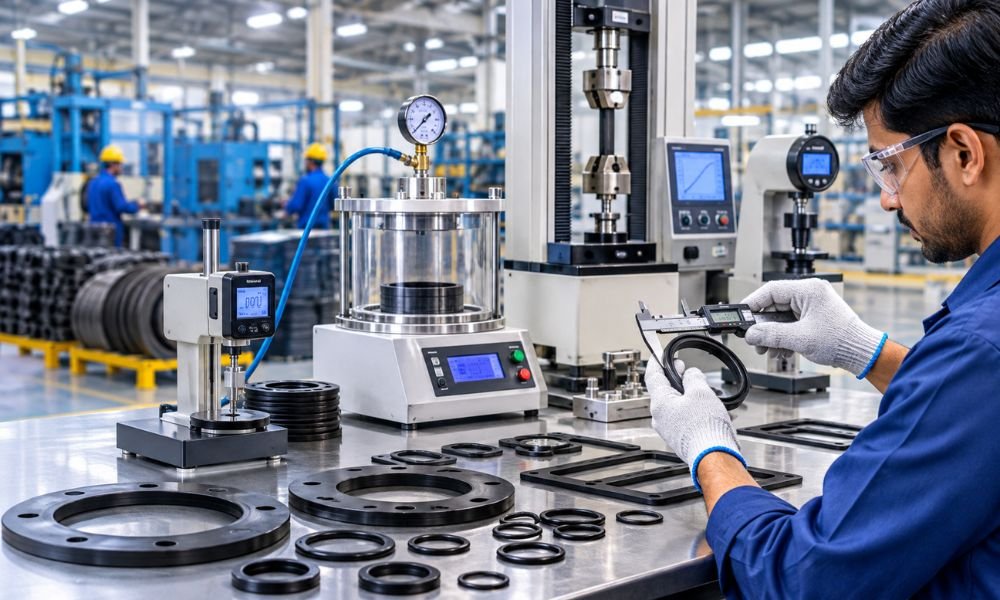
Rubber gaskets play an important role in many industrial applications where preventing leakage, maintaining pressure, and ensuring proper sealing are essential. They are commonly used in automobiles, machinery, manufacturing equipment, pipelines, pumps, and several other industries. Although a gasket may look like a small component, its performance can directly affect the efficiency, reliability, and safety of an entire system. This is why product testing is an important part of the manufacturing process.
Top rubber gasket manufacturers in India understand that producing a gasket is not just about selecting rubber material and giving it the required shape. Every product must meet specific performance requirements before it reaches the customer. Proper testing helps manufacturers identify material defects, check product dimensions, and evaluate how a gasket performs under different working conditions. It also helps businesses maintain consistent quality and build long-term customer trust.
Why Product Testing Is Important in Rubber Gasket Manufacturing
Product testing helps manufacturers confirm whether a gasket is suitable for its intended application. Different industries have different sealing requirements. For example, an automotive gasket may need to withstand engine heat, oil exposure, and pressure, while an industrial gasket may require resistance to chemicals, water, or continuous mechanical stress.
Without proper testing, even a small manufacturing defect can lead to leakage, equipment damage, frequent maintenance, or unexpected downtime. Testing allows manufacturers to identify such problems before products are supplied to customers.
It also helps maintain consistency between different production batches. When manufacturers follow standard testing procedures, they can ensure that every gasket meets the required specifications. This is particularly important for industries that depend on reliable sealing components for their daily operations.
Checking the Quality of Raw Materials
The quality of a finished rubber gasket depends heavily on the materials used during production. Rubber compounds can differ in terms of flexibility, hardness, temperature resistance, and chemical compatibility. Selecting an unsuitable material can affect the gasket’s ability to maintain a proper seal.
For this reason, manufacturers inspect and test raw materials before starting the production process. They evaluate whether the selected rubber compound meets the requirements of the intended application.
Common material properties that may be checked include hardness, tensile strength, elasticity, and resistance to environmental conditions. These tests help manufacturers understand how the material may behave during actual use.
Choosing the right material at the beginning also reduces the chances of product failure and unnecessary manufacturing waste. It allows manufacturers to produce gaskets that are better suited to the operating conditions specified by their customers.
Testing Hardness and Flexibility
Hardness and flexibility are two important properties that influence gasket performance. A gasket that is too hard may not compress properly against the sealing surfaces, while an excessively soft material may deform under pressure.
Manufacturers use hardness testing to check whether the rubber material falls within the required range. A Shore hardness tester is commonly used for measuring the hardness of rubber materials.
Flexibility is equally important because gaskets need to adjust to minor surface irregularities and maintain contact between two connected components. Testing helps manufacturers understand whether the material can handle compression without losing its sealing properties.
These checks are particularly useful when manufacturing gaskets for automotive engines, industrial machines, pumps, and other equipment where consistent sealing is necessary.
Evaluating Tensile Strength and Compression Set
A rubber gasket is often exposed to continuous pressure during operation. It must maintain its shape and sealing ability without tearing or permanently deforming. Two important tests used to evaluate these properties are tensile strength testing and compression set testing.
Tensile strength testing measures how much pulling force a rubber material can withstand before breaking. It provides information about the material’s strength and resistance to mechanical stress.
Compression set testing evaluates how much permanent deformation remains after a rubber sample has been compressed for a specific period under controlled conditions. This is important because gaskets need to recover sufficiently after compression to maintain effective sealing.
These tests help manufacturers select suitable rubber compounds for applications involving repeated pressure, vibration, and long operating hours.
Checking Temperature and Chemical Resistance
Many rubber gaskets operate in environments where they come into contact with heat, oils, fuels, water, or industrial chemicals. These conditions can gradually change the properties of rubber materials.
High temperatures may cause some rubber compounds to become hard or lose flexibility. Similarly, exposure to unsuitable oils or chemicals can result in swelling, cracking, or material deterioration.
To reduce these risks, manufacturers conduct temperature and chemical resistance tests according to the application requirements. They may expose rubber samples to specific temperatures or fluids and observe changes in their dimensions, weight, hardness, and physical condition.
Such testing is particularly important for automotive, chemical processing, oil and gas, and industrial machinery applications. It helps ensure that the selected material is compatible with the environment in which the gasket will be used.
Dimensional Accuracy and Visual Inspection
Even when a gasket is manufactured using good-quality rubber, incorrect dimensions can affect its performance. A gasket must fit properly into its designated space to create an effective seal.
Dimensional inspection involves checking important measurements such as inner diameter, outer diameter, thickness, shape, and other application-specific dimensions. Measuring instruments and inspection gauges help manufacturers verify that the finished product matches the required specifications.
Visual inspection is another essential quality check. During this process, manufacturers look for visible defects such as cracks, cuts, uneven surfaces, air bubbles, incomplete edges, and other manufacturing imperfections.
These checks help prevent defective products from moving to the packaging and delivery stages. They also reduce the possibility of fitting problems and performance issues at the customer’s end.
Testing Gaskets Under Application-Specific Conditions
Laboratory testing provides useful information about rubber material properties, but manufacturers must also consider how a gasket will perform in its actual application.
Different products face different operating conditions. Some may be exposed to high pressure, while others need to withstand continuous vibration, changing temperatures, or contact with different fluids.
Depending on the product and its intended use, manufacturers may conduct additional performance tests to evaluate sealing efficiency and durability. For example, leakage testing can help determine whether a gasket maintains an effective seal under specified pressure conditions.
Application-specific testing allows manufacturers to understand potential performance limitations and make necessary improvements before supplying the product. It also helps customers select gasket solutions that match their equipment requirements.
How Testing Helps Maintain Consistent Manufacturing Quality
Product quality should not depend on a single successful production batch. Customers expect every order to meet the agreed specifications, especially when gaskets are used in large-scale industrial operations.
Regular testing throughout the manufacturing process helps maintain this consistency. Manufacturers can inspect incoming materials, monitor production quality, and evaluate finished products before dispatch.
When testing identifies a problem, the production team can investigate its possible cause. The issue may be related to material selection, mould design, processing conditions, or manufacturing techniques. Corrective action can then be taken to prevent similar problems in future batches.
A structured quality control process also supports better production planning, reduces material wastage, and helps manufacturers improve their manufacturing practices over time.
What Buyers Should Look for in a Rubber Gasket Manufacturer
Product testing is an important factor to consider when selecting a rubber gasket manufacturer in India. Buyers should understand whether the manufacturer follows suitable quality inspection procedures and can meet the technical requirements of their applications.
It is useful to ask about the types of rubber materials available, testing facilities, dimensional inspection methods, and product specifications. Buyers can also check whether the manufacturer can provide relevant test reports or quality documentation when required.
Another important consideration is manufacturing experience. A manufacturer familiar with different industrial requirements may be better prepared to understand application-specific challenges and recommend suitable gasket materials.
Communication also matters. Sharing details about operating temperature, pressure, fluid exposure, and equipment design helps manufacturers understand what the gasket needs to handle.
Conclusion
Product testing is an essential part of rubber gasket manufacturing because it helps ensure that every component meets the required quality and performance standards. From raw material inspection and hardness testing to compression set evaluation, dimensional checks, and application-specific testing, each step contributes to producing reliable sealing solutions.
For buyers, choosing a manufacturer that gives proper attention to testing can help reduce product failures, maintenance requirements, and unexpected equipment downtime. Quality-focused manufacturers understand that a gasket’s performance depends on much more than its appearance.
Celofin Gasket recognises the importance of product quality and application requirements in gasket manufacturing. When selecting rubber gaskets for industrial or automotive use, buyers should consider material suitability, manufacturing quality, dimensional accuracy, and appropriate testing procedures to make a well-informed decision.
Don’t miss: What Buyers Should Know About Engine Gasket Manufacturers in India