An engine relies on well-sealed connections to operate efficiently and prevent unwanted leaks. Engine gaskets seal the gaps between components, helping keep oil, coolant, and combustion gases in their proper places. A damaged or incorrectly fitted gasket can cause fluid leakage, overheating, poor engine performance, and costly repairs.
Automotive service centers, spare parts dealers, and industrial businesses need a reliable source for components that meet their quality requirements. Choosing the Best Engine Gasket Manufacturer in India involves checking product quality, material suitability, manufacturing standards, and the ability to supply gaskets according to specific engine requirements.
Since different engines operate under varying temperatures and pressure conditions, a gasket suitable for one application may not work for another. Understanding these differences before placing an order can help you select the right product and avoid unnecessary maintenance issues.
1. Identify the Exact Gasket You Need
The first step is to determine which engine gasket your application requires. Engines contain several sealing points, and each gasket serves a specific purpose.
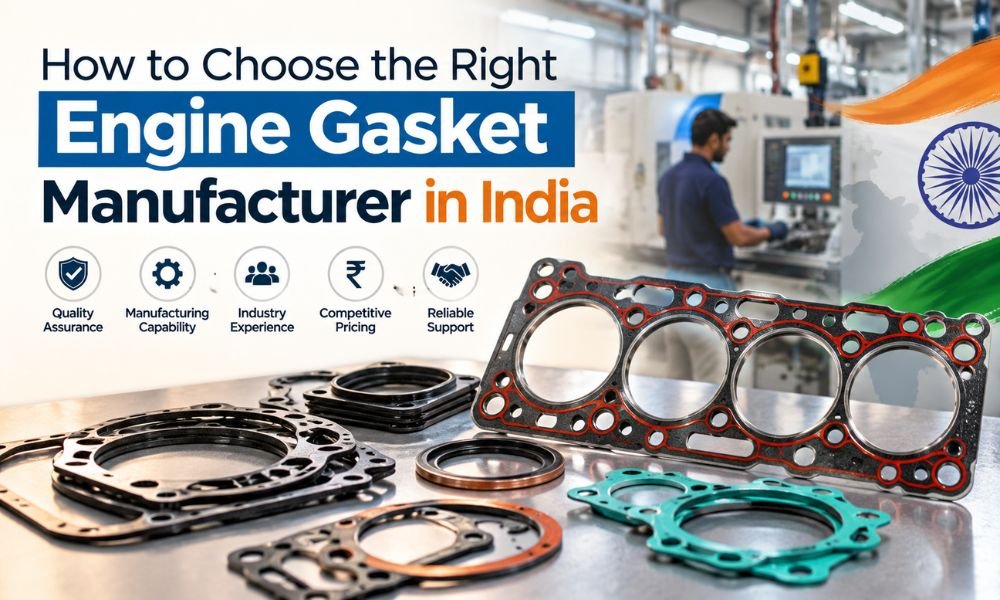
The cylinder head gasket forms a seal between the engine block and the cylinder head to prevent leaks. An oil pan gasket helps prevent lubricant leakage, while intake and exhaust manifold gaskets seal their respective connections.
These components operate under different conditions, so selecting a replacement based only on its appearance can cause compatibility problems.
Check the engine model, part number, dimensions, and original equipment specifications before contacting a supplier. When ordering gaskets for different vehicles or equipment, keep an organised list of the exact part numbers needed for each application. Providing accurate details helps the manufacturer identify the appropriate product and reduces ordering mistakes.
2. Pay Attention to Material Selection
The material used in an engine gasket affects its ability to withstand heat, pressure, vibration, and contact with engine fluids. Choosing the wrong material can result in premature wear or sealing failure.
Depending on the application, engine gaskets may be manufactured using composite materials, multilayer steel, metal-based constructions, or specialised rubber compounds for particular sealing points.
For example, multilayer steel gaskets are commonly used in many modern engines because of their ability to handle demanding combustion conditions when designed for the application. Composite materials may be appropriate for other engine designs, depending on the specified requirements.
When discussing your needs with a supplier, explain the operating conditions and intended use. Ask about the available material options and whether they meet the relevant engine specifications.
A higher price does not always mean the material is the right choice for your application. It is the material that provides the required sealing performance under the conditions in which the engine operates.
3. Examine Manufacturing Precision
Engine components are designed to fit together with specific dimensions and tolerances. Even a small error in gasket thickness, opening placement, or overall shape can affect installation and sealing.
When evaluating an engine gasket manufacturer, ask about the production methods and inspection procedures used for the products you need. Manufacturing processes may involve precision cutting, stamping, forming, coating, or moulding, depending on the gasket design.
It is also worth checking whether the manufacturer can produce components according to technical drawings or established specifications.
For customised orders, confirm the required dimensions and tolerances before production begins. If a sample is available, compare it with the original component or approved drawing.
Accurate manufacturing helps ensure that the gasket fits properly and performs as intended once installed.
4. Review Quality Testing Procedures
Even if a gasket appears to be in good condition, it may not deliver the performance needed for its intended use. This is why quality testing should be considered before finalising a supplier.
Ask how the manufacturer checks material consistency, dimensions, thickness, surface finish, and other characteristics relevant to the product. Depending on the gasket type, additional tests may be required to assess material strength, compression behaviour, or sealing performance.
If you are purchasing in bulk, enquire about batch inspection and the methods used to maintain consistency between orders.
You can also request samples or relevant inspection reports before making a larger commitment. For applications with strict technical requirements, confirm whether the supplier can provide the necessary test records and quality documentation.
These checks help you assess whether the product is suitable for your application instead of relying solely on the manufacturer’s assurances.
5. Assess Technical Experience and Product Range
A supplier’s technical knowledge can be valuable when dealing with different engine models and specialised requirements. Manufacturers that understand gasket design and material behaviour may be better equipped to address questions about compatibility and product selection.
Review the supplier’s product range and check whether it covers the engine categories relevant to your business. These may include passenger vehicles, commercial vehicles, agricultural machinery, or industrial equipment.
If you need a less common gasket, ask whether the manufacturer can work with technical drawings, physical samples, or specific part references. Discussing your requirements in detail can help determine whether the supplier has the necessary production capabilities.
It is also useful to check how the company handles specification changes and technical queries. Clear explanations and accurate product information can make purchasing decisions easier.
6. Compare Quotations Carefully
Price is an important consideration for automotive businesses, particularly when ordering replacement components in large quantities. However, the lowest quotation does not always offer the best overall value.
A poorly matched gasket can cause installation problems, repeated repairs, or additional labour expenses. Such costs may exceed the difference between two suppliers’ prices.
When comparing quotations, check the material specification, product dimensions, order quantity, packaging, delivery charges, and any custom manufacturing costs. Make sure each supplier is quoting for a product with equivalent requirements.
For regular purchases, discuss bulk pricing and the terms available for repeat orders. Ask for a clear breakdown of the quotation so that you can understand the actual cost.
A balanced decision considers price alongside product suitability, quality, and the reliability of future supplies.
7. Confirm Stock Availability and Delivery Timelines
Delivery schedules can directly affect businesses that supply replacement parts to workshops or customers. When a required gasket is unavailable, repairs may be delayed and inventory planning can become difficult.
Before placing an order, ask about current stock, production lead times, minimum order quantities, and the ability to fulfil larger requirements.
If you need several gasket models, check whether the supplier can provide the required range within a practical timeframe. For customised products, clarify whether the estimated delivery period includes sample approval and manufacturing.
You should also understand how the supplier communicates unexpected delays or changes in availability. Reliable updates help you manage stock and make realistic commitments to your customers.
8. Check Documentation and Customer Support
Good customer support is especially useful when you need help identifying a part, confirming specifications, or resolving an issue with an order.
Ask whether the supplier provides product information, material details, inspection records, and applicable certifications where required. If your business follows specific purchasing or quality procedures, confirm that the available documentation meets those needs.
You should also consider how the supplier handles incorrect deliveries, damaged products, and replacement requests. Clear communication about these matters can prevent misunderstandings later.
Customer reviews and business references may provide additional insight into service quality, but they should be assessed alongside technical capabilities and documented product information.
9. Think About Long-Term Supply Requirements
If your business regularly purchases engine gaskets, it is worth choosing a supplier that can support ongoing requirements rather than focusing only on the first order.
Discuss repeat-order availability, expected purchase volumes, lead times, and the ability to maintain consistent specifications. These details are important for distributors and workshops that need dependable access to frequently used components.
A stable supplier relationship can also make it easier to plan inventory, manage purchasing costs, and address technical questions when they arise.
Before entering a long-term arrangement, establish clear expectations for product quality, delivery schedules, and the process for handling any issues.
Conclusion
Choosing an engine gasket supplier involves more than finding a product at a reasonable price. Material suitability, dimensional accuracy, quality testing, technical experience, and dependable delivery all contribute to a successful purchase.
Before selecting an Engine Gasket Manufacturer in India, confirm your engine requirements and compare suppliers using the same product specifications. Request samples and supporting documentation when necessary, and discuss delivery arrangements before placing a bulk order.
For businesses evaluating gasket suppliers, Celofin Gasket is one option to consider during the selection process. Assess its available products and manufacturing capabilities against your specific requirements before making a final decision.
Taking a careful approach can help reduce compatibility issues, support reliable engine performance, and make long-term purchasing more manageable.
Don’t miss: What to Consider Before Selecting a Rubber Gasket Manufacturer in India